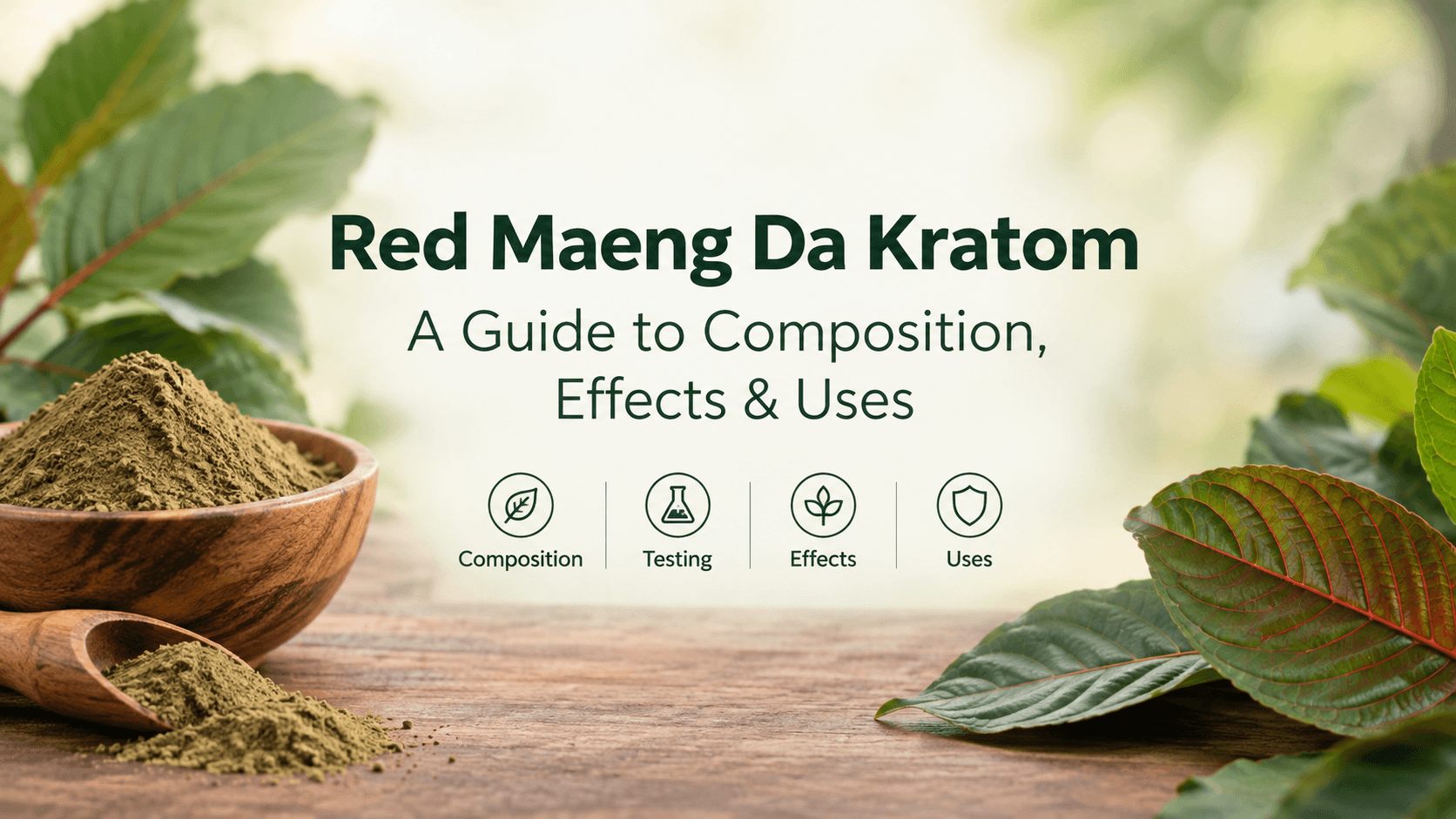
What Is Red Maeng Da Kratom? A Guide to Its Composition, Effects, and Uses
Red Maeng Da is a commonly recognized kratom variety associated with the red-veined side of Mitragyna speciosa. For consumers researching red kratom powder, understanding its botanical identity, alkaloid profile, testing standards, and responsible-use considerations is more useful than relying on broad claims about what it can do. At KO Kratom, we focus on transparent product information, batch testing, and clearly documented specifications so customers can make informed decisions.
What Is Red Maeng Da Kratom?
Kratom comes from the leaves of Mitragyna speciosa, a tree native to Southeast Asia. Different kratom products can vary in their alkaloid profiles based on botanical material, processing, sourcing, and other factors.
Red Maeng Da kratom generally refers to kratom marketed under the Maeng Da name with a red-vein or red-associated profile. However, names alone do not establish a standardized chemical composition. This is why we recommend looking beyond the product name and checking the available specifications and laboratory documentation.
When evaluating red kratom powder, consider:
- Botanical identity and sourcing information
- Available batch-specific laboratory results
- Reported alkaloid concentrations
- Heavy-metal and microbial testing
- Product specifications and labeling
- Applicable federal, state, and local regulations
Our Red Maeng Da Bali Blend
At KO Kratom, our Red Maeng Da Bali Blend is a proprietary combination of Red Bali and Red Maeng Da. We provide the product's specifications directly on our Red Maeng Da Bali Blend product page.
The product page currently lists a 1.5% minimum mitragynine specification and a less-than-400-PPM 7-OH specification. These are product specifications and should not be interpreted as a guarantee of a particular subjective response.
For customers researching red kratom powder, this distinction matters. A product specification tells you what the manufacturer states as a batch requirement; a laboratory report provides analytical results for the particular sample tested.
What Characteristics Are Associated With Red Maeng Da?
People often search for red kratom powder because they want to understand how red-associated kratom products may fit into their routines. Consumer experiences can vary considerably, and laboratory measurements do not establish that a product will produce a specific effect for every person.
Our Red Maeng Da Bali Blend is positioned as an evening-oriented blend for people interested in physical decompression and a mental wind-down after their day. These descriptions represent product positioning, not medical claims or guarantees.
Understanding the Alkaloids
Mitragynine is one of the primary alkaloids found in kratom. 7-Hydroxymitragynine, commonly abbreviated as 7-OH, occurs naturally in kratom in much smaller amounts.
A laboratory report can provide additional context by showing the concentrations detected in a particular sample. This is one reason we make batch-specific laboratory documentation available through our KO Kratom Lab Results page.
What Does Our Laboratory Testing Include?
Our published laboratory documentation separates testing into several categories rather than treating every analyte as one broad measurement.
Kratom Alkaloids (UHPLC-DAD)
The published COA includes testing for:
- Mitragynine
- 7-Hydroxymitragynine (7-OH)
- Paynantheine
- Speciogynine
- Speciociliatine
- Total Mitragyna alkaloids
Heavy Metals (ICP-MS)
Heavy-metal screening includes:
- Arsenic
- Cadmium
- Lead
- Mercury
Microbials & Pathogens
- Salmonella
- E. coli
- Coliforms
- Yeast and mold
Frequently Asked Questions
What is red maeng da kratom?
Red maeng da kratom is a botanical product marketed under the Maeng Da name with a red-associated profile. Product composition can vary, so consumers should review the specific product's documentation and laboratory results rather than relying only on the name.
What is red kratom powder?
Red kratom powder is powdered botanical leaf material from Mitragyna speciosa marketed as a red-associated product. The chemical profile of individual batches varies, which is why batch testing provides essential consumer data.
How is red maeng da kratom tested?
KO Kratom products undergo analytical testing for kratom alkaloids via UHPLC-DAD, heavy metals screening via ICP-MS, and microbial pathogen analysis.
Where can I find laboratory information for KO Kratom products?
You can review our current KO Kratom Lab Results to see published batch-specific laboratory documentation before ordering.